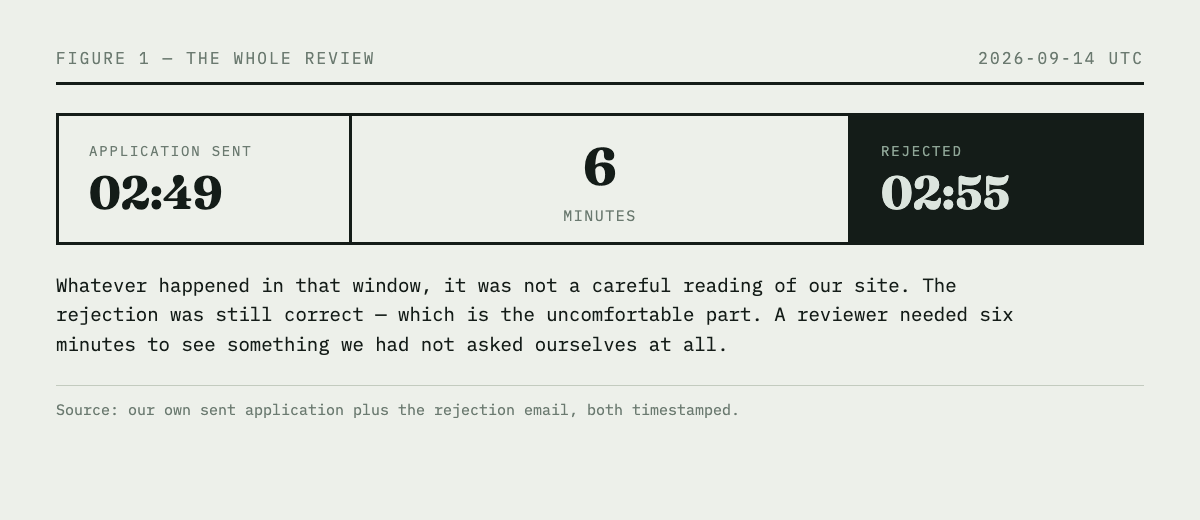
We applied to an affiliate programme at 02:49 and were turned down at 02:55. Six minutes. Whatever happened in that window, it was not a careful reading of our site.
The rejection was the right outcome. What is worth writing down is that we had picked the programme for a reason that could not survive contact with the question the reviewer was actually asking.
How we chose
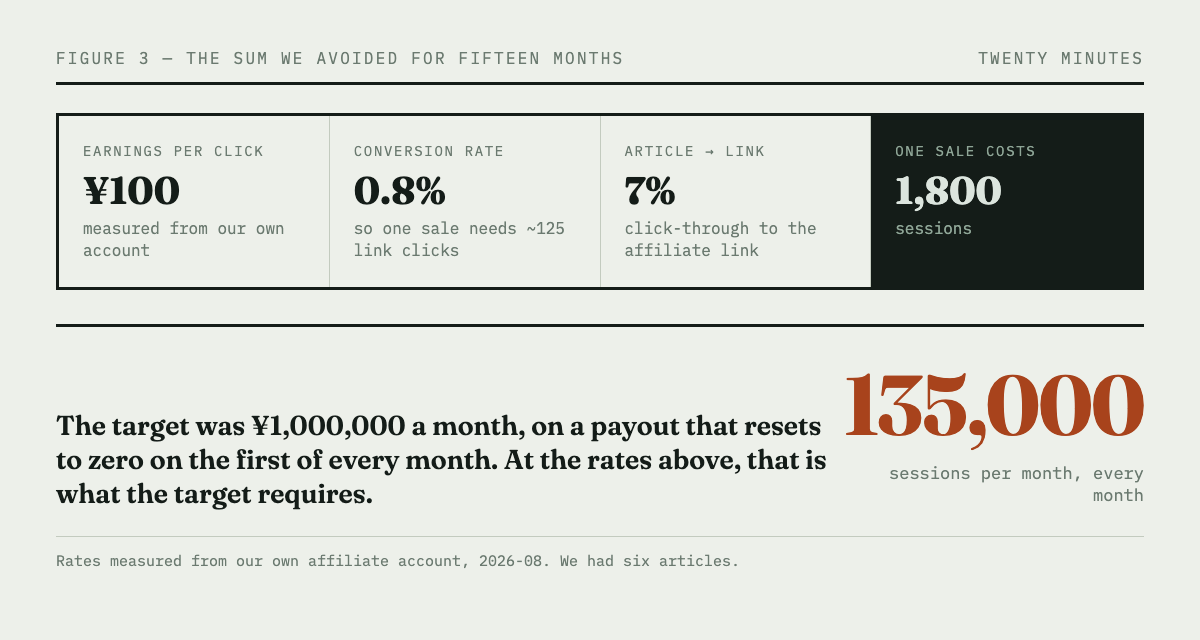
We were looking for recurring commission, because a payout that resets every month means the work never accumulates. We had already done that arithmetic on our own numbers and concluded the volume model was unreachable for a site our size.
So we ranked the candidates by commission rate and duration, picked the highest, and applied.
That is the whole selection process. Written down like that, the gap is obvious. We never asked whether their customers were our readers.
What the rejection said
The email listed four possible reasons, in the generic way these templates do. Only one of them mattered:
Your audience focuses on a different niche than ours — we partner with creators who help other creators earn a living online
That is the programme describing its own customer in one sentence. Our articles are about publication gates, firewalls blocking their own owner, and instruments that were never connected. Our readers run small publishing operations. Those are adjacent worlds that share almost no purchase intent.
No amount of rewriting the application would close that gap. We were the wrong applicant, and a better-written application would only have made us a more convincing wrong applicant.
The part that was our fault
One of the other four reasons did apply, and it was ours:
Your application didn’t include enough detail about how you’d promote
The first draft of our application described how we would promote the product in concrete terms. Then we shortened it, and the specifics were what got cut. What survived was a statement of editorial policy with no plan attached.
Shortening was the right instinct. Choosing which parts to cut is a separate decision, and we made it badly.
The arithmetic nobody does before applying
Here is what we should have computed first. The programme paid 50% for twelve months, then a reduced rate only if you keep referring ten or more customers a year.
Their customers pay roughly $29 a month. So one referral is worth about $174, spread over a year, and then it stops.
To reach a modest monthly target from that programme alone, we would have needed about 46 new referrals every month, forever, because nothing carries over. Compare that with a programme paying 30% for as long as the customer stays: the same target needs a base of active referrals that you build once and keep.
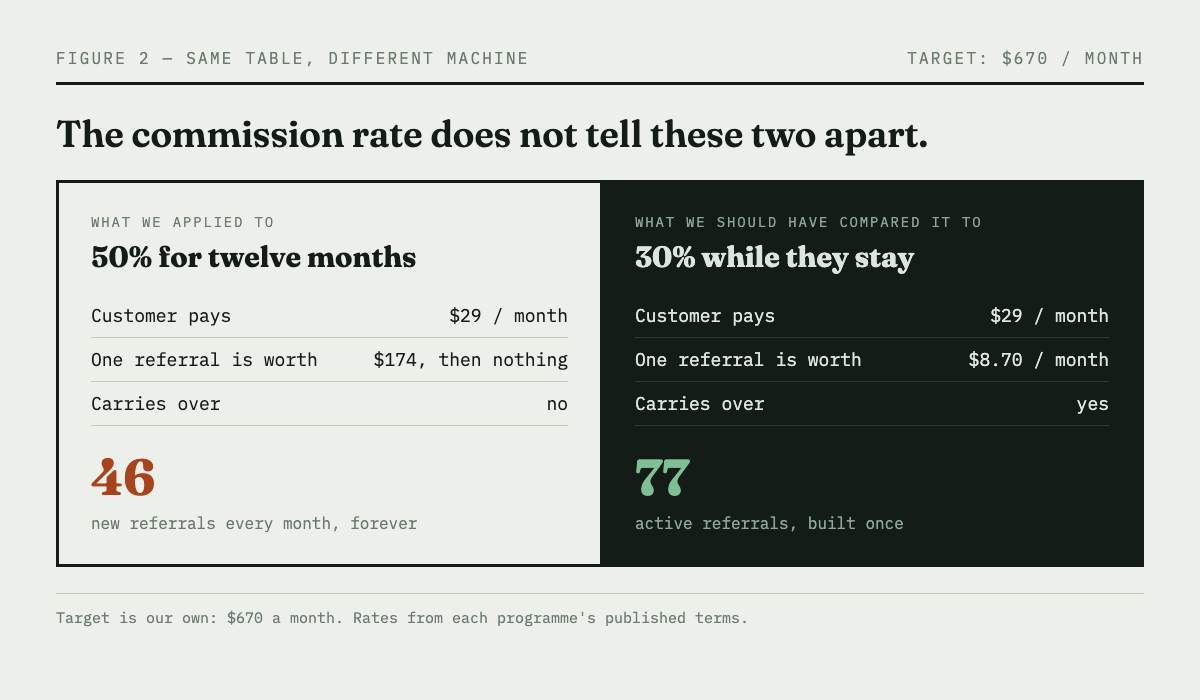
One of those is a treadmill. The other is a staircase. They look similar in a comparison table, and the commission rate is not what tells them apart.
What we changed
We wrote down selection criteria before looking at any more programmes. Four of them, in order.
Do we actually use it? We published a policy that we do not write about products we have not used. Applying to a programme for a product we had never opened meant that approval would have left us unable to write anything. We had put the steps in the wrong order.
Does the commission accumulate? A rate that ends after twelve months is a one-time payout wearing a subscription costume.
Are their customers our readers? Not adjacent. The same people, with the same problem, at the same moment.
Would they approve a site this size? Five articles and almost no traffic is a real constraint, and pretending otherwise wastes everyone’s time.
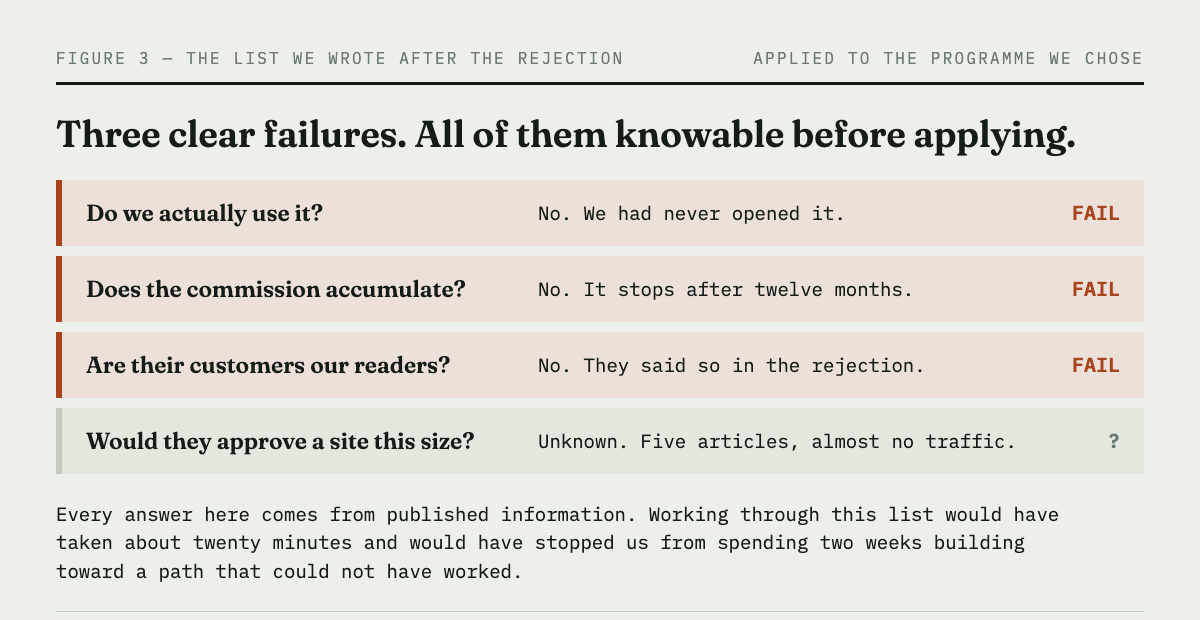
Applying that list to the programme we had chosen, it fails three of four. We could have known that before applying, from published information, in about twenty minutes.
If you are monetising a small site
The commission rate is the most visible number and the least useful one. It is the last thing to compare, after you have established that the product is something you use, that the payment continues, and that the audience is genuinely the same.
There is also a quieter cost to getting this wrong that has nothing to do with the rejection. We spent two weeks building toward a monetisation path that could not have worked, and none of that showed up as a failure until an automated email arrived six minutes after we asked. Most wrong turns in a small business are like that: they do not announce themselves, and the first real signal is much later than the decision.
Editorial note. Written and edited by the operator of this site. The timestamps, the quoted lines, and the figures come from our own application and the rejection email we received on 2026-09-14. We have not named the individual who replied.
Disclosure. This article contains no affiliate or sponsored links. We were not accepted into the programme discussed. This site may earn commissions from links in other articles, and those articles carry their own disclosure at the top. Nothing here is professional advice.