Google’s guidance on scaled content abuse draws the line in a place a lot of people misread. It is not about whether a machine wrote the draft. It is about whether a person actually exercised judgment before it went live. That distinction sounds reassuring until you try to prove it. What does “a person reviewed this” look like six months later, when the only evidence is that someone remembers skimming it?
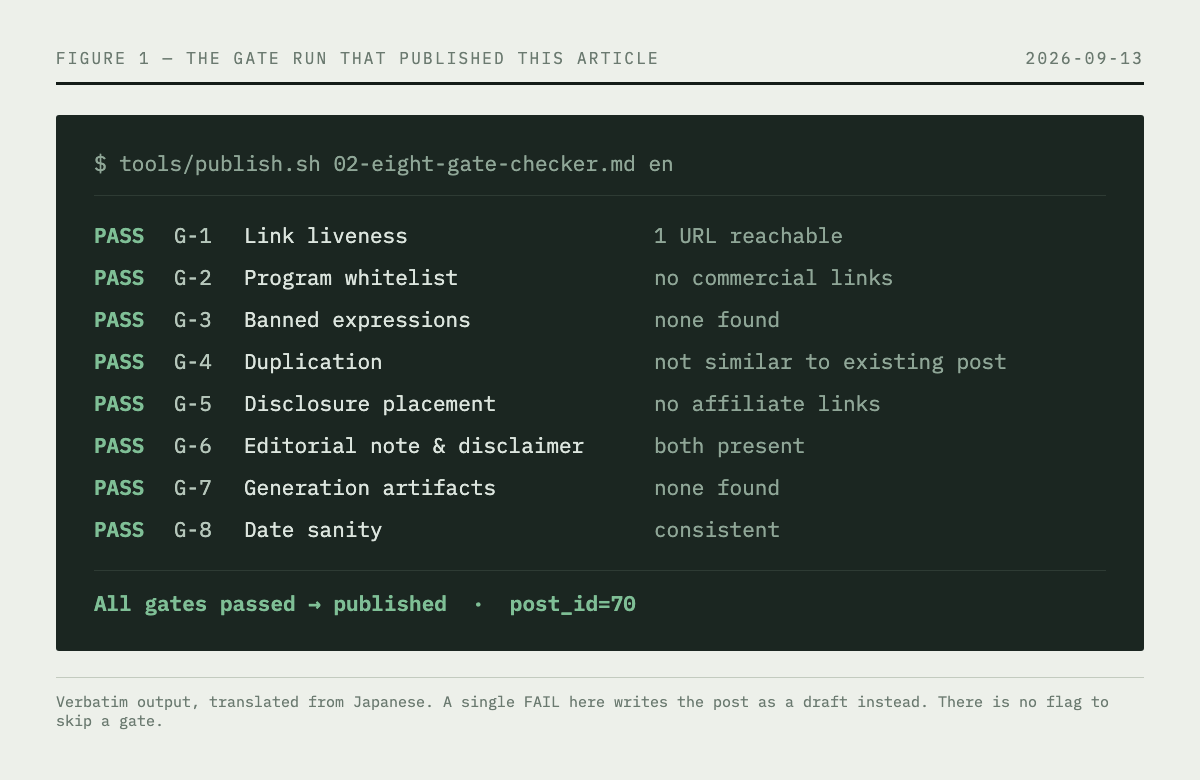
We run a small publisher where the drafts are machine-written and the decisions are not. We have written before about what breaks when you hand the work to agents, and this is the control we built afterward. In September we stopped relying on memory and built a checker: eight gates, every article, fail-closed. Nothing publishes unless all eight pass.
Then we pointed it at our own live site, which had seven published articles on it. It failed six of them.
What the eight gates check
The gates are deliberately boring. Each one exists because something specific went wrong, either to us or to someone whose postmortem we read.
G-1: every outbound link resolves. A HEAD request to each URL in the body. Link rot is slow and invisible, and a dead link in a comparison article is the reader’s last impression of you.
G-2: every commercial link points to an approved program. The article can only link to advertisers we have an actual approved relationship with. On our English site, where we have no approved programs yet, this gate blocks commercial links entirely rather than trusting a future editor to remember that.
G-3: no banned expressions. A pattern list: income promises, absolutes, manufactured urgency. More on how badly this one behaved in a moment.
G-4: not a near-duplicate of anything already published. Sequence similarity against the live corpus, pulled from the CMS at check time rather than from a local index that drifts.
G-5: commercial relationships are disclosed above the fold. Only fires when G-2 found a commercial link, and then it requires the disclosure inside the first 400 characters, not in a footer.
G-6: editorial responsibility and disclaimer are both present. Who stands behind this, and what it is not.
G-7: no generation artifacts. Stray model chatter that survived into the draft.
G-8: dates are sane. A surprisingly common failure: an article published in 2026 that confidently discusses “this year’s” pricing from 2024.
What the first run found
Six of seven live articles failed, and the failures were not subtle.
One article carried an income figure in its own title, a specific monthly yen amount presented as an outcome. It had been sitting on the front page for weeks. Nobody had decided to publish that claim; a draft had simply never been argued with.
Three articles were near-duplicates of each other. Same topic, same structure, marginally different phrasing, all three indexed and competing with each other for the same query. That is the exact pattern the scaled-content guidance describes, and we had produced it without noticing, because each one looked fine on the day it was written.
Seven of seven were missing any link to our own disclosure and editorial pages. Those pages had existed since June. Not one article pointed at them. Every individual article had been reviewed by a person; the property as a whole had been reviewed by nobody.
Separately, and outside the gates, we found the sitemap had been frozen since June 9 and was serving eleven URLs that no longer existed.
None of this required sophistication to find. It required something that looks at every article the same way every time, which is precisely the thing a human reviewer stops doing around article four.
The gates were wrong before they were right
The first version of G-3 was close to useless, and this is the part most write-ups skip.
It flagged a Japanese headline meaning roughly “the fundamentals, so you don’t fail” as a no-risk claim. It is not a claim about risk; it is an ordinary way to title an explainer. It flagged an article about selling AI prompts because the word “prompt” appeared in our list of generation artifacts. It flagged the phrase “right now” in a sentence where nothing was being sold.
On the English side the pattern list had the same disease in a different accent. Early drafts of the rules would have flagged a sentence stating there is real risk in unattended automation, because it contained the word risk near a negation. They would have flagged “the server costs twelve dollars a month” as a price claim and “the site earned zero” as an income claim. Those are the sentences we most want to be able to write.
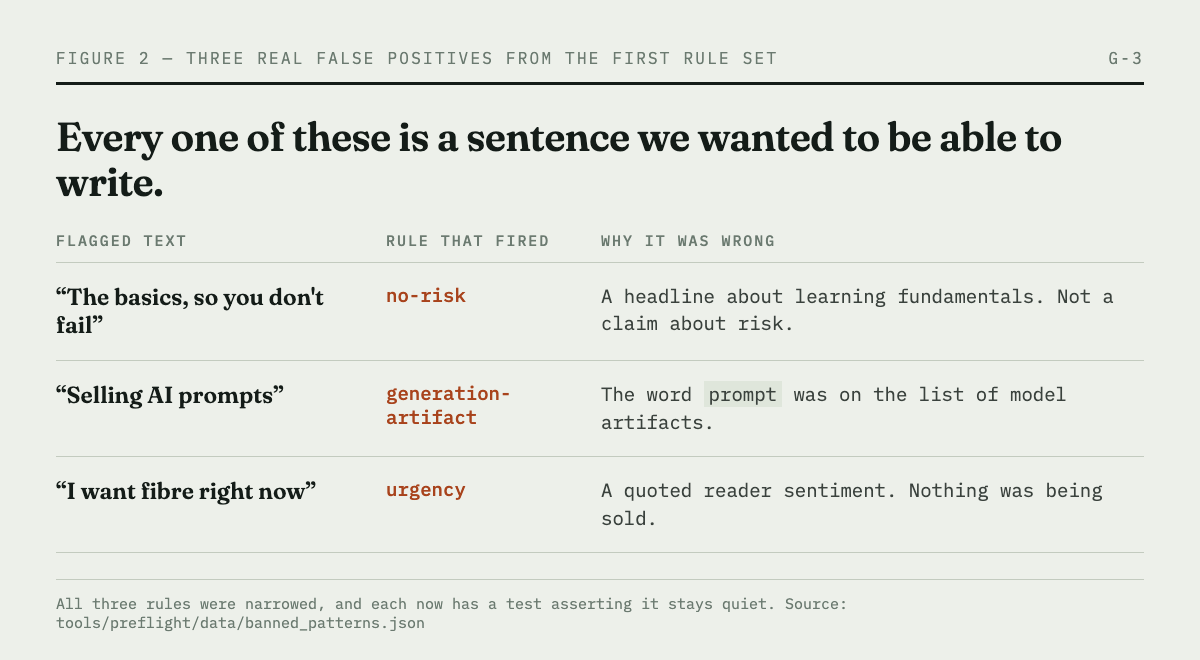
So we narrowed the rules and wrote tests that assert non-detection. Fifty tests now, and a meaningful share of them exist to prove the checker stays quiet on honest sentences. The fixtures are real headlines from our own deleted drafts, not invented examples.
This matters more than the detections do. A checker with a high false-positive rate does not get tuned. It gets bypassed, and then it is worse than nothing, because the bypass becomes the habit and the green checkmark becomes a lie.
What it does not do
The gates cannot tell you whether an article is worth reading. They cannot detect a confident factual error, an outdated recommendation, or a comparison that quietly favors the advertiser paying the most. Every one of those still requires a person who knows the subject.
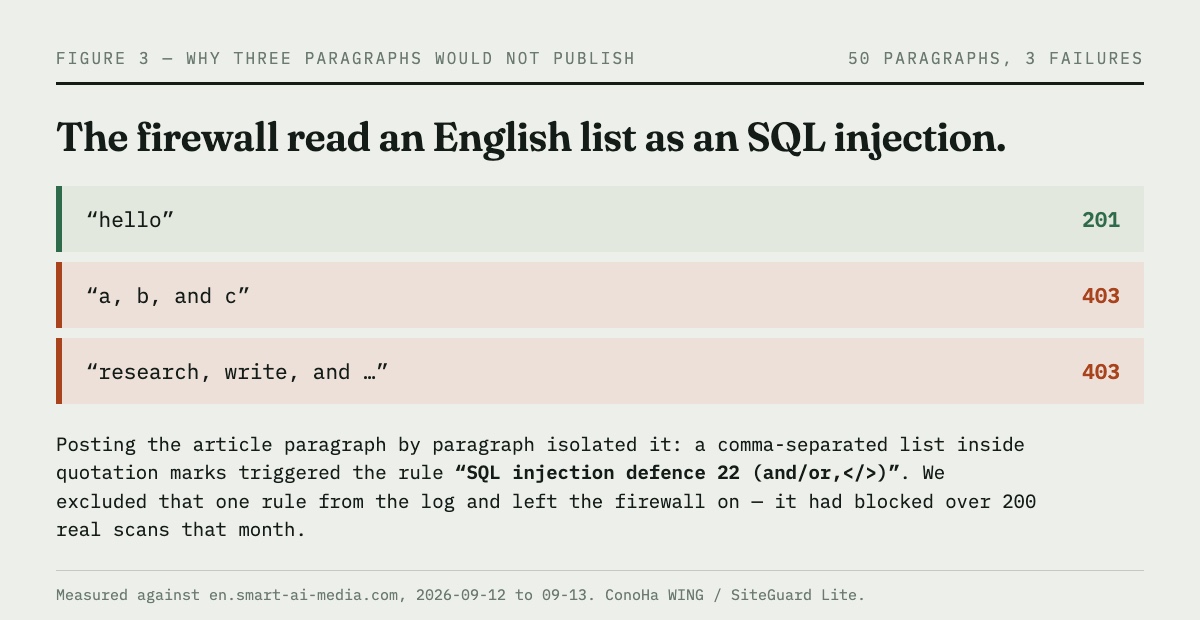
What the gates do is clear the floor, so that the human review is spent on judgment instead of on checking whether the links work. That is the whole argument. Automated checks are not a substitute for editorial oversight; they are what makes the scarce oversight land somewhere useful. We learned how narrow that floor really is a few days later, when all eight gates passed three articles that reached readers as raw markup.
If you want to build one
You do not need a framework. Ours is a few hundred lines of Python using only the standard library, and it runs in under a minute against the live CMS.
Start with the failure you have already had. If you have shipped a dead link, write G-1 first. Run it against your existing published articles before you write another word, because the archive is where the evidence is, and it will tell you which gates you actually need.
Then make it fail closed, and resist the urge to add an override flag. The moment there is a documented way to skip the gates under deadline pressure, the gates describe your intentions rather than your output.
We are about seven weeks into this and the checker has caught things a human review already passed, more than once. That is not an argument that the humans were careless. It is an argument that reading an article and auditing an article are different tasks, and only one of them gets harder the more articles you have.
Editorial note. Written and edited by the operator of this site. Every figure here comes from our own systems and is reproducible from our logs. Where we describe a failure, we found it on our own property, not someone else’s.
Disclosure. This article contains no affiliate or sponsored links. This site may earn commissions from links in other articles, and those articles carry their own disclosure at the top. Nothing here is professional advice.
Leave a Reply